

"It was the best of times, it was the worse of times..."
was Dickens' immortal assessment of of the stage being set for revolution, which, happily, he saw as eventually leading to a better life for all: "I see the evil of this time and of the previous time of which this is the natural birth, gradually making expiation for itself and wearing out." "A.I." being one of the great issues of our day, TLA brings you Two Approaches to consider. NB: Don't give up with the first one. Some things are just wrong, and they won't work for a relatively long time. For the good news, be sure to scroll down to the second article, where vastly more people are doing it right. -- Ed.
Greg Brockman: Meet the ChatGPT Billionaire Funding Trump, Pushing A.I. and Designing Hi-Tech Weapons
Alan MacLeod | June 4, 2026 | MintPress News | Analysis
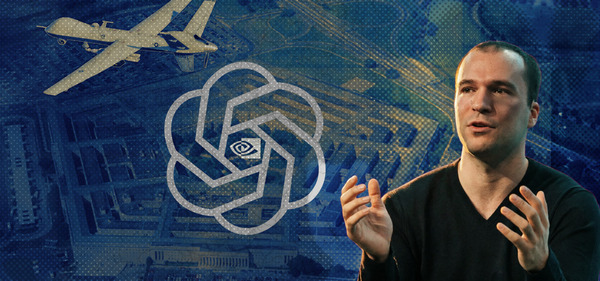
He may not be a household name yet, but Greg Brockman is among the world’s most powerful individuals. The OpenAI co-founder is one of President Trump’s richest and most generous financial backers, and is spending tens of millions of dollars to fight A.I. regulation. He is using OpenAI to produce hi-tech and futuristic surveillance and military systems, with Israel using its technology in its genocide in Gaza.
MintPress News sheds light on the tech billionaire quietly pulling the strings in Washington, D.C.
Trump's Billionaire Backer
Politics is an expensive business to be in. Thankfully for the Republican Party, they can rely on the support of Greg Brockman. Together with his wife, Anna, the OpenAI co-founder donated $25 million to MAGA Inc. – a super PAC funding President Trump and his allies.
MAGA Inc. relies almost entirely on billionaires like Brockman for its money. Sixty-two percent of the $305 million it raised came from donors pledging $5 million or more, and 96% from pledges over $1 million.
The figure of $305 million is completely unprecedented, dwarfing all previous records for a president’s super PAC. This, despite the fact Trump is legally barred from running for president again. Nevertheless, during his time in office, he has ignored so many laws and protocols that many are predicting he will attempt to do so regardless.
The decision to bankroll Trump’s political ambitions has provoked alarm among many employees of OpenAI – the company that launched A.I. chatbot, ChatGPT. Some have suggested that Brockman’s contributions go beyond merely quid pro quo political lobbying and represent an effort to change the course of the country.
A.I. PAC
Brockman himself has claimed that he is not political. His largest previous donation was $5,400 to Hillary Clinton back in 2016 – a paltry sum for someone worth an estimated $25.5 billion. Yet this new Trump contribution is part of a wider wave of influence, as the billionaire enters the political sphere in order to advance his own interests, and those of OpenAI.
The Brockmans have also sunk $50 million into Leading the Future, a bipartisan super PAC aimed at promoting the adoption of A.I. into a wide variety of sectors, and attacking and unseating skeptical legislators calling for increased regulation of the industry.
“This mission, in my mind, is bigger than companies, bigger than corporate structures,” he told WIRED Magazine, adding, “We are embarking on a journey to develop this technology that’s going to be the most impactful thing humanity has ever created. Getting that right and making that benefit everyone, that’s the most important thing.”
The public, however, are deeply skeptical. A recent poll found that public confidence in A.I. is very low – and falling. Only 5% of Americans say they trust A.I. a lot, and 77% worrying that the technology could represent a fundamental threat to humanity.
Many politicians agree, and wish to get a hold on the technology before it is too late. Yet the A.I. Industry is already worth hundreds of billions of dollars, making the likes of Brockman and co-founder Sam Altman some of the richest people on the planet. The worry is that the A.I. Industry will find its newfound wealth to lobby hard against legislation that would limit its growth, spending millions to crush anti-A.I. lawmakers.
To this end, they already have a model to follow in AIPAC. The American Israel Public Affairs Committee floods money into races involving candidates critical of Israel in an effort to cajole and coerce U.S. politicians into supporting Israel.
Earlier this month, Representative Thomas Massie – a fierce critic of Israel and the war on Iran – lost his Kentucky primary, after AIPAC and other pro-Israel groups spent tens of millions of dollars attacking him and funding his opponent, Ed Gallrein.
Massie’s Kentucky primary was the most expensive in U.S. history. The second- and third-costliest primary races in history also featured AIPAC successfully defeating Israel critics, Jamal Bowman and Cori Bush.
If many in the tech world have their way, unqualified support for A.I. could become the default position like championing Israel, with lawmakers wary of taking on the industry, lest they lose their seats. They certainly have the money to create an A.I. PAC of sorts; OpenAI alone is already valued at some $852 billion.
Using A.I. To Crack Down on Anti-A.I. Dissent
President Trump is already moving to block moves to regulate the industry. In December, he signed an executive order preventing states from passing their own laws limiting A.I., something that 38 states had already done.
The reasons for the decision were not clear. Trump himself stated that the plan was to have “one central source of approval.” But his A.I. czar, David Sacks, said that it represented an attempt to push back against many states’ “onerous” rules, and to help the U.S. compete with China.
Trump himself is personally invested in A.I., having bought stocks in Nvidia, AMD, CoreWeave, KLA Corp., and other industry stocks, even while deciding the laws around how it will be allowed to develop.
Perhaps more worryingly, new documents show that the Trump administration is planning to use the power of the national security state to crack down on what it calls a new wave of “anti-tech extremism.”
More than 1,000 pages of leaked government documents show that the FBI and the Department of Homeland Security are anticipating a wave of domestic upheaval, as A.I. destroys communities across the country. Automation-related job losses and the building of gigantic data centers will remove water and electricity from public use, ramping up the price of what little remains.
As one report notes:
“The chaotic atmosphere that may result from emergent A.I. technology in the next five years may fuel large-scale protests that devolve into civil unrest and anti-tech violent extremist activity, especially in large urban areas such as New York City.”
Thus, the government has already begun to surveil a new and extremely broad category of Americans. Ironically, they will be using A.I. to do so, monitoring individuals’ output on social media, messages, location data, and more.

China Promotes "Tech for Good" to Safeguard Human Rights
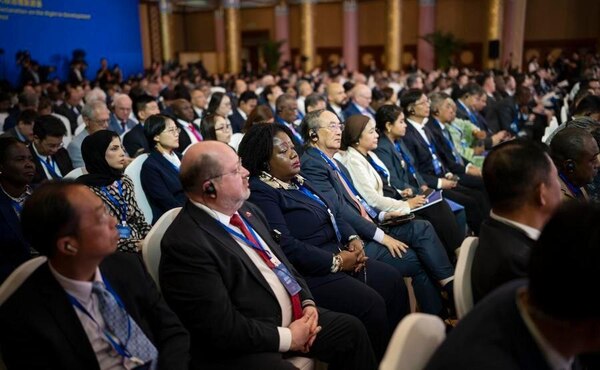
This photo taken on June 11, 2026 shows attendees during the opening ceremony of the 2026 Forum on Global Human Rights Governance in Beijing, capital of China. (Xinhua/Cai Yang)
BEIJING, June 12 (Xinhua) -- At the 2026 Forum on Global Human Rights Governance, Jaber Alsalaj picked up the English and Arabic copies of the National Human Rights Action Plan of China (2026-2030). His sights were fixed on a chapter: creating a better digital and intelligent life.
This keen interest was far from a sudden impulse. Days before the forum, Alsalaj, senior advisor with the Independent Permanent Human Rights Commission of the Organisation of Islamic Cooperation, took a field trip to east China's Zhejiang Province.
In Zhejiang, he saw firsthand how cutting-edge technology is changing people's lives. The experience inspired him to dive deeper into China's strategic vision. He told Xinhua that China's efforts to use technologies, including artificial intelligence (AI), to advance human rights protection, are brilliant.
Alsalaj was particularly captivated by a digital system of Hangzhou Yanglingzi School, which offers special education. The system, developed over 13 years, tracks cognitive, social, and rehabilitation data to generate a personalized growth profile for each child.
Unlike general education, special education serves a diverse population. While some students require intensive language training, others need ongoing emotional intervention or long-term physical rehabilitation.
Teachers who once depended mainly on their experience are now making use of digital tools, including AI learning companions, to analyze subtle developmental changes and craft personalized education plans.
"Valuing every individual's uniqueness is the original aspiration of education and our answer to nurturing students in the digital age," said Yu Linya, principal of the school, noting that the essence of special education lies in helping every child discover their potential and chart their own unique path to growth.
Abdul Latif Rashid, former president of the Republic of Iraq, who joined the same field trip to the school, echoed Alsalaj's excitement, calling for technology to promote human rights and human well-being. Rashid was so drawn to the students' creations that he requested a painting of a blossoming pink tree. He plans to exhibit the artwork in Iraq to share the school's story.
 A senior citizen wearing an exoskeleton walking aid device shops at a market in Hangzhou, east China's Zhejiang Province, Feb. 24, 2025. (RoboCT/Handout via Xinhua)
Beyond the classroom, the role of technology is extending to other groups, ensuring a more inclusive life for the elderly and people with disabilities. For instance, delegates tested several exoskeleton robots in Zhejiang.
"This is the meaning of 'tech for good.' I hope that we're gonna use them in a very good and humane direction," said Davor Bošnjak, Head of Cabinet of the Ministry of Civil Affairs of Bosnia and Herzegovina.
Xiao Junyong, a professor at the Beijing Institute of Technology, said that using technology to compensate for physical impairments, thereby enabling people with disabilities to participate equally in the digital society, is a vivid embodiment of the principle of "tech for good."
"A defining feature of China's AI development is its deep integration into communities, education, and public services, rather than just cutting-edge large models. This perfectly embodies China's people-centered approach, truly harnessing technology for the well-being of the people," said Huang Jinrong, deputy director of the Center for Human Rights Studies under the Chinese Academy of Social Sciences.
This people-centered approach extends far beyond Zhejiang. At the Hubei Humanoid Robot Innovation Center in central China's Hubei Province, Teresita Ang See, Executive Trustee of the Kaisa Heritage Foundation, asked a humanoid robot, "I'm 77 this year. Any advice for me?" The robot gently replied, "Take care of your health and walk a bit slower."
The center uses 23 simulated real-world scenarios to drive tech breakthroughs through practical applications. "China's tech serves people, which is remarkable," she said, adding that she hopes these robots can reach more countries.
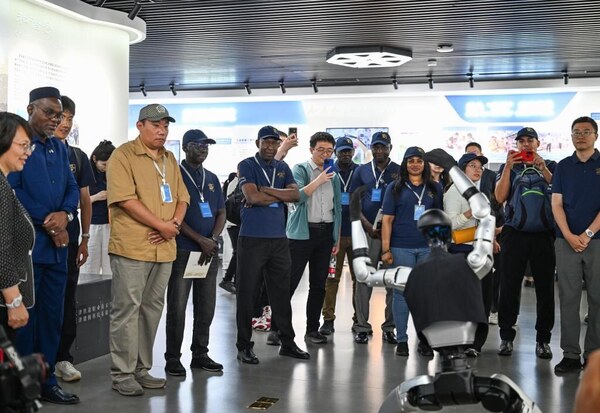 Members of a multinational delegation view a humanoid robot performance at the Tianjin Light Industry Vocational Technical College in north China's Tianjin, on June 8, 2026. (Xinhua/Zhao Zishuo)
A limited offer...
Macleod re: Brockman: "The billionaire is a new and important figure in domestic politics...simultaneously flooding the country with money, supporting lawmakers that will promote [its] interests, and ensuring widespread public opposition to A.I. does not find its voice in Washington, D.C."
Dickens: "I see the evil of this time and of the previous time of which this is the natural birth, gradually making expiation for itself and wearing out."
Subservience or sovereignty. Two approaches.
And, for now, it's still our choice.