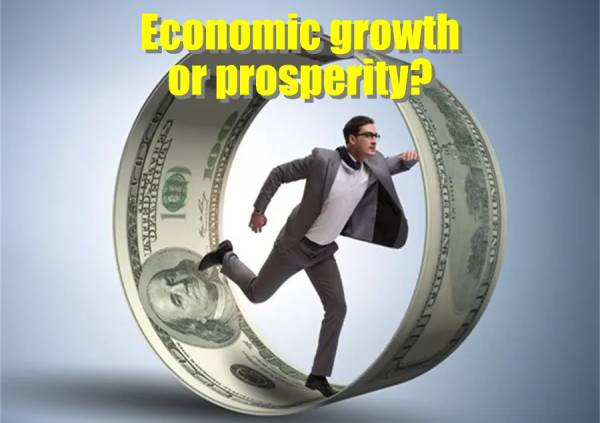
Not all economic growth is desirable. Ultimately it's about choices: what future do we want to build? We've no right to abdicate on making those choices because future depends on it.
The term “economy” gets tossed about in the media every day, personified in statements like, “the economy is slowing down,” “the economy is stagnant,” or “the economy is booming.” The unspoken assumption is that we all know exactly what “the economy” is. But what most of us refer to when we speak about the economy are the statistics about certain economic activities.
But statistics say nothing about the nature of those activities as though that was irrelevant. We can put our faith in the “invisible hand” and assume that economic activity reflects the desires and needs of a society. But that faith is largely misplaced.
The hamster wheel economy
Suppose you lived in a community where an old but functional and well-maintained bridge connected two river banks, enabling people and goods to move across. The bridge would represent a capital good - a real piece of community’s wealth. Its existence would only marginally impact the community’s ‘GDP’ since its maintenance would carry some cost. Regardless, it should be obvious that the bridge would be an extraordinarily useful piece of social capital to have.
Now suppose someone, some expert, fresh out of Harvard or Oxford came up with the idea that, to boost the community’s economy (GDP), they should blow up the bridge and build a new one. The community could raise credit, hire demolition crews, destroy the old bridge, bring in architects and building contractors, and construct the new bridge. Many people would get paid from the community’s new credit, and all this spending would boost business, employment and the GDP.
But in replacing the old bridge with the new one, the community’s wealth wouldn’t change. Over time, it would even diminish since the community would now have to service the debt it incurred in replacing the old bridge with the new one. The implication of this dynamic is that, “economic growth” does not necessarily create wealth or improve a community’s standard of living. Depending on the nature of the economic activity, it could even do the opposite.
The obvious conclusion is that economic policy shouldn’t amount to an unthinking pursuit of growth. Instead, policy should be formulated around the desired social objectives. That imposes the question: what objectives we should desire? What do we wish for our labour to achieve? What should we create? What improvements in our lives do we desire? Ignoring all these questions and blindly pursuing growth could be like running in a hamster wheel, expending energy and going nowhere.
What’s unsustainable can’t go on forever
Blind pursuit of economic growth could be dangerous. It is also utterly unsustainable. Consider this: if your wealth consisted of a single ounce of gold and your policy objective was to grow this ‘hoard’ at a rate of 5% per year, in 1000 years your hoard would exceed the mass of the entire planet. At some point, the laws of nature would force you to rethink your objectives.
Today, we appear so set on chasing economic growth that all other policy objectives are subordinated to it, or disregarded as irrelevant. This is because our policy makers have almost entirely abdicated on their responsibilities, deferring economic policy to the central planners bankers who in turn view society exclusively through the prism of their monetary system. Economies must grow (in nominal terms), else the whole system implodes. Therefore, any growth is desirable, even if it’s pathogenic to society.
If waging nonstop wars boosts the GDP, then war is good. If pushing vaccines and endless boosters also boosts the GDP, then vaccines are great. If curing diseases reduces the GDP because people spend less on medicines and treatments, then obviously, we mustn’t cure diseases. Today, health care sector is close to 20% of U.S. GDP. If everyone was suddenly restored to perfect health, the GDP would sustain a depression-level collapse.
Whose choices?
Blowing up a bridge to build it back is an absurd choice, but it is in fact similar to destroying people’s health in order to cure them (except you can’t actually cure people since that would collapse “the economy”). In spite of these absurdities, we’ve somehow come to accepting this state of affairs, and few people question it at all. But even if we ignore the absurdities, the system really is unsustainable, which means that sooner or later, it will come to a head.
At that point, we will have to supplant the system with a different one, which should hopefully be a life-sustaining economic model. There is no reason why designing a life-supporting system that enhances and gives meaning to people’s lives should not be our objective. Otherwise, we implicitly accept serfdom or something even worse: being hackable animals, as our Davosian overlords planned for us. If we accept that, then we deserve it. But nobody has the right to accept it on behalf of future generations.