
Longitudinal evidence from 25 years of the Lothian Birth Cohort 1921
A study in the February, 2026 Journal of Environmental Psychology supports the health and enjoyable longevity benefits of gardening. Get your gloves on! ~ Ed
Gardening, healthy aging, and longevity: Longitudinal evidence from 25 years of the Lothian Birth Cohort 1921
Abstract
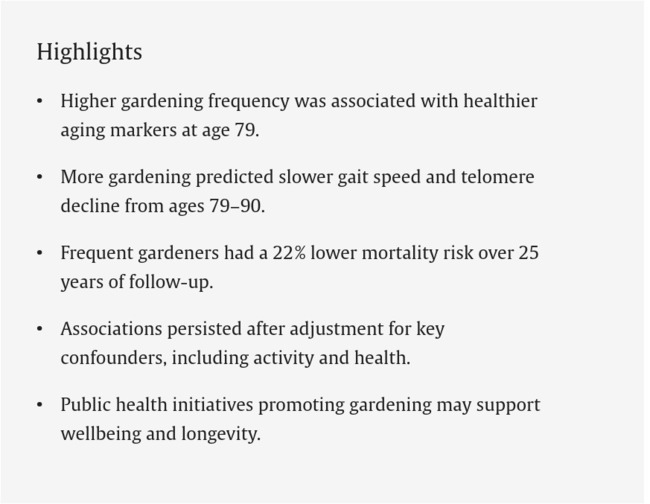
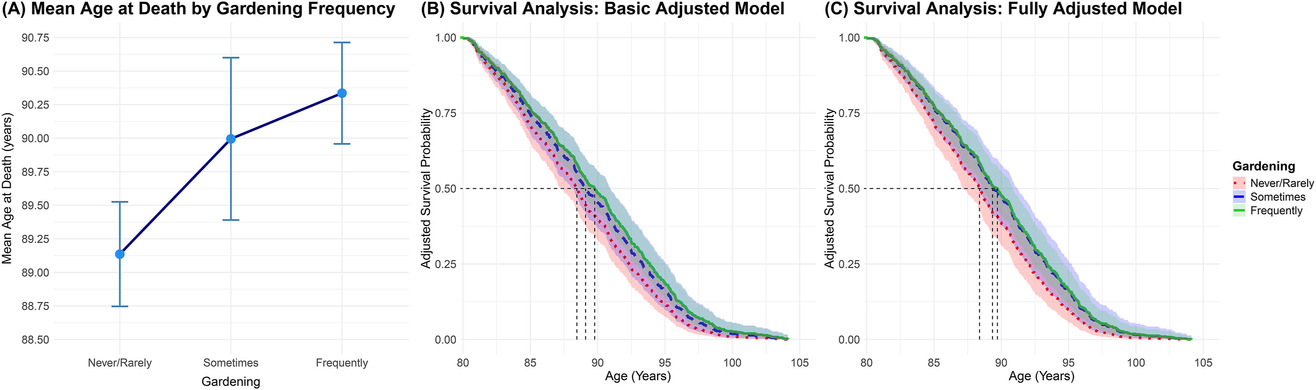
Gardening is a common leisure activity among older adults, yet its potential to support healthy aging remains underexplored, particularly in longitudinal contexts and across multiple aging domains. This study investigated whether gardening frequency was associated with psychological, physical, and biological aging markers, as well as mortality, in the Lothian Birth Cohort 1921 (LBC1921). Gardening frequency was assessed via questionnaire at a mean age of 79 years (baseline: 1999–2001) in 475 participants. Aging markers were measured at 79, 83, 87, and 90 years. Psychological markers (quality of life, psychological wellbeing) were self-reported; physical function markers (lung function, gait speed, grip strength, functional ability) were objectively assessed; and biological markers (telomere length, DNA methylation-based PhenoAge) were blood-derived. Survival was tracked using 25-year mortality linkage data. Analyses included linear regression, growth curve modeling, and Cox proportional hazards, adjusted for individual- and neighbourhood-level covariates. Of the sample, 207 gardened frequently, 78 sometimes, and 190 never or rarely. At baseline (age 79), higher gardening frequency was associated with better psychological wellbeing, stronger physical function, and longer telomeres. Longitudinally, more frequent gardening predicted slower declines in gait speed and telomere attrition from age 79 to 90. Frequent gardeners had a 22 % lower mortality risk (HR = 0.78, 95 % CI: 0.62–0.97) than those who never or rarely gardened. Associations were not substantially confounded by sociodemographic, lifestyle, or physical activity factors. Our results suggest that gardening may support wellbeing and longevity, with potential implications for aging in place for older adults.
Introduction
With the global population of older adults rising rapidly, supporting healthy aging has become an urgent public health priority (Gianfredi et al., 2025). By 2030, one in six people worldwide will be aged 60 or over, and this number is expected to double to 2.1 billion by 2050 (World Health Organization, 2022). In the UK, nearly one in five people are aged 65 and over, with many experiencing multiple chronic health conditions, functional decline and cognitive impairment (Centre for Ageing Better, 2024). These demographic trends highlight the growing need for preventive, low-cost, and scalable lifestyle interventions to promote health and independence in later life. Gardening may represent one such intervention, with growing evidence suggesting it supports health and wellbeing across the lifespan, including benefits to physical health, positive affect, life satisfaction, and increased engagement in physical and social activities (Chalmin-Pui et al., 2021; Cheng et al., 2010; Cheng & Pegg, 2016; Fjaestad et al., 2023; Genter et al., 2015; Gulyas et al., 2024; Harding et al., 2022; Hassan et al., 2018; Howarth et al., 2020; Kingsley et al., 2023; Krols et al., 2022; Kunpeuk et al., 2020; Panțiru et al., 2024; Scott et al., 2015; Scott et al., 2020; Shiue, 2016; Soga et al., 2017; Wang et al., 2024; Wang & Boros, 2025; Wang & MacMillan, 2013). These benefits may in turn support healthier aging and help mitigate age-related declines, which is the focus of the current study.
As an activity typically carried out around or near the home, gardening may also promote autonomy and a sense of connection to the local environment, both key components of ‘aging in place’ (Pani-Harreman et al., 2021). Additionally, gardening provides direct exposure to green space, which is independently linked to mental wellbeing, lower mortality risk, and reduced incidence of chronic disease in later life (De Keijzer et al., 2020; Twohig-Bennett & Jones, 2018), suggesting that gardening may deliver benefits through both behavioural and environmental pathways.
Despite the promising findings to date, systematic reviews and meta-analyses highlight several limitations in the current literature (Howarth et al., 2020; Panțiru et al., 2024; Soga et al., 2017; Wang & MacMillan, 2013; Sia et al., 2020; Van den Berg & Custers, 2011). Many studies rely on cross-sectional designs, self-reported outcomes, or small and unrepresentative samples, limiting conclusions about causality or long-term effects. Objective indicators—including directly measured physical function and blood-based biomarkers—are rarely included, and longitudinal research remains scarce. Moreover, while gardening is a particularly popular leisure activity among older adults, few quantitative studies have specifically addressed this demographic (Wang & MacMillan, 2013). Existing studies in older samples tend to focus on general health or psychosocial outcomes, leaving other important domains of aging, such as cognitive function or biological aging, largely unexplored (Machida, 2019; Scott et al., 2020; Sommerfeld et al., 2010; Van den Berg et al., 2010). For example, no studies to date have examined gardening in relation to telomere length, a key biomarker of cellular aging (Chakravarti et al., 2021; Eppard et al., 2024; Rossiello et al., 2022).
Horticultural programmes in residential care settings further support the health-related benefits of gardening in later life. Studies across North America, the UK, and Japan have reported pre-post improvements in depression, anxiety, social relationships, and physical fitness (e.g., aerobic endurance, agility) following gardening activity sessions (Nicholas et al., 2019; Park, Lee, Lee, et al., 2016; Wang et al., 2022). However, this evidence comes mainly from small, short-term studies in clinical or institutional populations, limiting generalisability to community-dwelling older adults (Yun et al., 2024).
A further challenge in evaluating the potential benefits of gardening is the multifactorial nature of health and aging, which are influenced by a wide range of interrelated social, environmental, and behavioural factors (Castruita et al., 2022). Variables such as education, socioeconomic status, neighbourhood quality, gender, and health behaviours (e.g., smoking, physical activity, and body mass index) are known correlates of health outcomes (Hemadeh et al., 2025; Mutz et al., 2021; Ng et al., 2020; Yoshida et al., 2022). If gardening behaviours are causally related to healthier aging (rather than simply being another indicator of general good health) then such associations would be expected to remain robust after adjustment for these covariates, which themselves offer quantitative indicators of health. Such correlational data are in a position to disprove, though not in a position to prove, causality. This makes the availability of suitable datasets particularly important. Large, prospective, community-based longitudinal studies of older adults that collect comprehensive life-course data provide valuable opportunities to test these relationships and characterise change in health outcomes over time. Understanding whether and how gardening supports healthy aging has implications for researchers, clinicians, and policymakers seeking accessible and sustainable interventions to promote wellbeing in older age.
Recent prospective studies of aging increasingly highlight the role of modifiable lifestyle behaviours in supporting mental and physical health in later life (Lafortune et al., 2016; Peters et al., 2019; Thomas et al., 2023). Building on this, our previous work with the same well-characterised cohort used in the current study, showed that gardening was associated with more favourable cognitive aging (Corley et al., 2024), indicating potential benefits that extend beyond commonly studied outcomes such as emotional health.
In the present study, we investigate whether gardening frequency is associated with baseline levels and trajectories of a broader set of aging markers—psychological wellbeing, physical function, biological aging, and mortality risk. We use data from the Lothian Birth Cohort 1921 (LBC1921)—a rich, longitudinal study following individuals from early old age into their 90s—with repeated health assessments over more than a decade, allowing examination of changes in key aging markers, alongside verified mortality linkage data. Baseline data on gardening activity, physical activity, and contextual factors such as socioeconomic background, lifestyle, and neighbourhood quality, enable adjustment for important potential confounders. Drawing on one of the longest-running aging cohorts worldwide, this study offers unique insight into how everyday interactions with the environment may contribute both to day-to-day wellbeing and to long-term survival.
Conclusion
In conclusion, this study provides evidence that gardening—a common, low-cost, and widely accessible behaviour—may contribute to healthier psychological, physical, and biological aging, and is associated with a meaningful reduction in mortality risk over decades. These results extend existing evidence by demonstrating that an everyday leisure activity is linked to long-term differences in functional and cellular aging in very old age. By identifying gardening as a feasible component of strategies that support independence and wellbeing, the findings highlight its potential relevance for public health, social prescribing, and environmental design.
In practice, these findings support the inclusion of gardening within health promotion and social prescribing initiatives for older adults, particularly those aiming to maintain mobility, wellbeing, and independence in later life. At a policy level, they underscore the importance of age-friendly housing and urban environments that enable access to safe, useable garden spaces. For research, the results highlight the need for more longitudinal, intervention, and quasi-experimental studies to test causality and determine the most beneficial forms of gardening and optimal exposure (frequency and duration) across diverse populations.
NOTE: The entire study, including Methods, Results, Discussion and Funding, is CC-BY-4.0 and is available on Science Direct Publication CC-BY-4.0