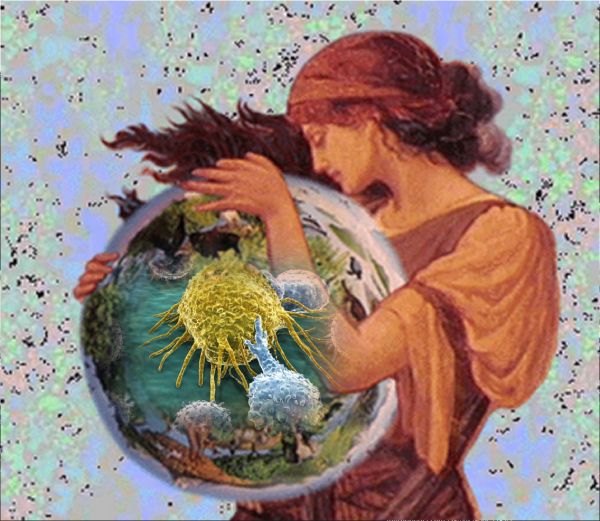
We like to call the natural world “Mother Nature,” but that’s a misnomer.
Nature may be the Mother of us all in an abstract sense, that of being the source of our lives, but She is not anthropomorphic. Nature is not a kindly grandmother who sends us birthday presents and cares about our well-being and looks out for safety.
No, in its most fundamental aspect, Nature is a set of rules that guide the development and manifestation of Life on earth. One example of these natural rules is that “Everything eats everything else.”
Some of the wildebeests or gazelles taking refuge at the African waterhole will be killed and eaten by lions. Although humans are inclined to think of ourselves as the alpha species on this planet — the pinnacle of the food chain — we too will become food for other species, usually after we die. If we die in the open, without burial, we will make good meals for scavenger species. If we are buried or cremated, as is typical, our remains will nourish bacteria. That’s how Life on earth works: everything dies or is killed and gets tossed back into the pot to provide food for continuing new Life.
Unlike us, Nature is not sentimental. In very real terms, Nature does not care about us at all. She does not give us special compensation nor intercede on our behalf. In fact, nature has neither a stake nor any concern about which species survives and prospers and which species dies off and goes extinct. In the Grand Parade of Life, individual players in the marchingband can and do change continually, but the Music of Life goes on without missing a beat.
Our problem as a species is not that we are unsuccessful. Quite the contrary, we have been so spectacularly successful that we are now in imminent danger.Why? Because the rules of Nature are based on balance and harmony, and we have become so successful and dominant that Life is now dangerously out of balance because of our growing numbers and prodigious activities.
In 1800, the world’s total human population was one billion people. Over the next century, the Industrial Revolution moved that previously slow growth curve into hyperbolic ascent. By 1930, world population had doubled, due largely tothe benefits of abundant and cheap energy. When I was born in 1949, wenumbered two and a half billion. Now, in 2017, as I approach the end of my 60s, we have reached more than seven billion, soon to be eight billion.
I’ve written often that there’s something disturbingly out of balance about a world with seven billion human beings, but only 400 Bengal Tigers. To repeat, Nature doesn’t care about either Bengal Tigers or human beings, but we should. Sadly, in the overall collective sense, we don’t. Yes, many people do indeed care about ecological balance, other life forms, and preservation of wild habitats. Overall, though, civilization cares very little for anything other than itself. So, we continue to convert habitat that once supported Tigers and many other wild species to human use, which means the end of Tigers. In fact, we are in the midst of the greatest mass extinction event since the Great Permian Extinction about 252 million years ago. Species are disappearing by the thousands, more every day, many of which we don’t even know about or have names for. And these extinctions are happening because of us — human beings — and our cumulatively negative impact on this extraordinary garden planet.
Despite humanity’s vainglorious history, during which we have often posed as conquerors of Nature and somehow above it, we are not separate from the natural world. We are part of that world, as is every living species on the earth — interconnected and mutually interdependent. The idea promoted by some religions that humans are meant to have dominion over Nature, or the economic philosophy that the earth has no innate value and is simply “resource” to be collected, harvested, dug up, refined, synthesized, or otherwise plumbed for whatever human use we care to put it, are particularly tragic and wrong-headed notions. Human beings are not the measure of all things, only of some things, and to believe otherwise is to engage in hubris and narcissism. Not only are such beliefs in ourselves as Masters of the Universe unbecoming, they are downright suicidal. In a very literal sense, humanity is dependent on millions of other species for our well-being and survival. The evolving crisis around honeybees and chemical disruption of their critical role in plant pollination for farming is but one small example of this larger truth.
Our economics are tragically mistaken. The obsessive focus on infinite growth and short-term profit pervert the very idea of commerce. Rather than considering business to be meaningful work for the family of humankind, we think of it only as the engine to create income and wealth. Work itself is reduced to an impersonal factor in the cost of doing business, to be minimized or eliminated however possible. Workers are hardly considered as people at all.
Economic theories can be argued, but the theories themselves are less the problem than the overwhelming urgency to squeeze out more and more profit, regardless of the negative impacts on the environment and our sanity. The old question, “What does it profit a man to gain the world and lose his soul?” continues to be relevant, however much we may try to ignore it. People bitch and moan about corporations, but we have largely accepted their domination.
None of what I’ve written here is particularly radical. It is plain common sense, but a kind of sense that is routinely ignored or mocked by the incessant drumbeat of advertising that forms the hypnotic propaganda hologram of mainstream culture: “CONSUME! You too can be happy, fulfilled, and well-loved if you simply buy that new car, flat-screen TV, and smart phone!” Advertising shows us loving families and happy social groups of friends “proving” that toys are all that matters.
Some people seem to feel that just recycling paper, plastic, and glass will avert the inevitable breakdown of modern civilization and save us from disaster. It won’t. We are way past those days of naïve 1970s-style kindergarten “environmentalism.”
Sure, I’m a creature of my times, as are most of us. I, too, am part of the problem. If I were able to live like a Norwegian Deep Ecologist in a humble cabin on the ocean shore, with no electricity, fishing and growing vegetables for my food, I would. But I can’t. I’m an old, damaged fart without the means to live off the grid, beyond civilization.
In a sense, that’s the situation in the collective. We’re all way too far gone to change direction, unless we are forced to do so by disaster.
And friends, I am very sorry to say that’s what’s coming. It may be slow, meaning incremental and sporadic, adversely affecting people in different regional pockets, or it may be faster than we expect and happen in ways that are more dramatic, but — one way or another — it’s coming. The Larsen Ice Shelf in Antarctica is disintegrating, and we’re in big trouble.
Throughout much of my life, I’ve tried to understand the perspective of those whose views of nature are in conflict with my own. I’m talking about people for whom industry and development are sacrosanct, people who believe that the economic value assigned to resources is all that matters, and people who are certain that technology will solve all our problems. Well, guess what? I’m done cutting such people any slack. Those idiots are dead wrong. They’re the same people who fracked Oklahoma into Earthquake Central and who now want to continue fracking there until the entire state blows up.
We cannot continue to live as we do. Sacrifices must be made. If we don’t make them by choice, they will be forced on us. Yes, those of us who are financially well-off enough will continue to drive our cars, fly in airplanes, shop in grocery stores, and buy more toys, at least for now. But that will change over the coming decade. Of course, the rich will be the last to have to give up their extravagant lifestyles, but even they are not immune from loss.
I neither espouse nor believe in “perfect harmony.” Such a state exists very rarely on this planet — or, for that matter apparently, anywhere else in the universe — usually not for long and never permanently. Efficiencies and balances are always relative and ever-changing. The plains cultures of nomadic native Americans were obviously closer to nature than our own, and certainly they saw themselves as part of a larger interconnected Life Force, but even they didn’t exist in perfect harmony with the natural world. When game for the hunt was exhausted in the territory around an encampment, or the river used for drinking water, washing, and waste disposal became fouled, they packed up and moved on to more pristine locations, leaving behind the trash and debris of human life. That’s just the way of things at our level.
The post-apocalyptic dystopian fantasies that Hollywood has been cranking out as entertainment for decades (a.k.a., “Mad Max”) may be merely expressions of our darker fears, or they could be prescient sneak previews about what’s coming. Predictions about how the future will look, however, are notoriously difficult to get right. The future is elusive and surprising in the forms it takes, and I don’t pretend to know the specific shape or timing of things to come. (Astrology can reveal some of the symbolism of our collective experience, but it’s not a crystal ball…)
Here we are, at the beginning of the profound change that will affect most of us, and perhaps all of us. We already know many of the risks we face as a civilization and a species — risks that are the cumulative result of how we’ve chosen to live — but we don’t yet know how reality will shape itself. That journey into the unknown will play out one day at a time.
To reiterate the title of this commentary, Nature doesn’t care about us. We have to care about us. Unfortunately, civilization is set up on the basis of “us versus them.” That’s how it’s been for 11,000 years, and that’s the way things are now — too much competition, too much exclusion, too few of us, and too many of them. Unless we change that arithmetic, we’re toast.
Early on in the development of civilization, when the total population of humans was small, the us versus them equation was a nasty by-product of human nature’s tribal tendencies, but it wasn’t fatal. We fought with those we considered “them,” tried to conquer or enslave “them,” and frequently killed “them,” both human and non-human.
Now, however, with more than seven billion of us on the planet, the ratio of us versus them has changed. “Us” has remained limited in numbers, while “them” has expanded exponentially. Empathy, compassion, and universal love have been pushed to the sidelines as elements in human nature. We need to move those qualities to center-stage, perhaps for the first time ever. The future of our species depends on this unnatural but necessary change in consciousness.
It would be miraculous if some shift in collective consciousness occurred that allowed such a change to greater inclusion, more of us, and fewer of them. My understanding of history suggests that such a mass event is unlikely. The only dependable way for that kind of profound spiritual maturation to happen is one person at a time. If we need a miracle, though, then we may as well try to create one ourselves.
As individuals, our challenge is to live as sanely as we know how, as simply as we can, and with as much love as our hearts can feel. I understand that this commentary contains precious little solace, but the good news is that love still matters. Doing what we can to let our love flow out to those we care for while expanding who we include as “us” — despite our fears and the trauma of these times — is meaningful, important, and worth the effort.
© 2017 by the author, all rights reserved. Reprinted by permission of the author.