The Iron law of oligarchy is a political theory, first developed by the German sociologist Robert Michels in his book 1915 Political Parties.
Michels was an anarcho-syndicalist at the time he formulated the Law. He later became an important ideologue of Mussolini's fascist regime in Italy. The simplest formulation of the 'Iron Law of Oligarchy': "Who says organization, says oligarchy."[1]
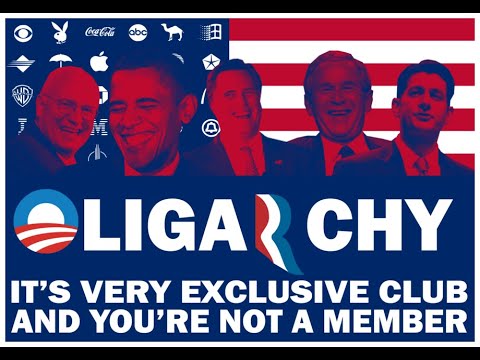
In essence Iron law of oligarchy postulate that any complex organization self-generate its own elite, an oligarchy that has disproportional influence on the decisions made in the organization. Such an elite is pretty autonomous from "rank-and-file" members and is little affected by elections. As such Iron law of oligarchy stands in stark opposition to pluralism and suggests that "participatory democracy" is a utopian ideal and that democracy is always limited to very narrow strata of existing oligarchy (top 0.01% in the USA). It also stands in opposition to state autonomy theory.
As such iron law of oligarchy is a powerful argument against possibility of "permanent stability" in human societies. As elite that got power degrades, newcomers want to displace it and such "regime change" often possible only by violent means. That's why the institutionalized mechanisms for "rotation of elite" is so important.
At the same time any revolution, at the end, is just a change on the top layer of elite. Which means that they seldom achieve stated goals, especially if such goals include equality and social justice. The fundamental distinction between the elite and rank-and-file members is always preserved and often enhanced. As Michels noted in his book Political Parties
...society cannot exist without a …dominant… or… political class, and that the ruling class, while its elements are subject to frequent partial renewal, nevertheless constitutes the only factor of sufficiently durable efficacy in the history of human development. [T]he government, or, … the state, cannot be anything other than the organization of a minority. It is the aim of this minority to impose upon the rest of society a “legal order” which is the outcome of the exigencies of dominion and of the exploitation of the mass …
Even when the discontent of the masses culminates in a successful attempt to deprive the bourgeoisie of power, this is … effected only in appearance; always and necessarily there springs from the masses a new organized minority which raises itself to the rank of a governing class…” (pp. 353-354).
The key here is that elite (oligarchy) on any complex organization always holds the lion share of political power and that this power is independent of any democratic elections or revolutions. Elite is an organized minority which always outmaneuver and outsmart the rank-and-file of the particular organization ("unorganized majority").
There is hierarchy within the elite too: it is composed of the "the top guns" and the sub-elites.
Robert Michels observations were based on the fact that the socialist parties of Europe, despite their democratic ideology and provisions for mass participation, were completely and irrevocably dominated by their leaders, just as the traditional conservative parties. Generalizing this phenomena he stated that all forms of organization, regardless of how democratic or autocratic they may be at the start, will eventually and inevitably evolve into oligarchies.
The elite actually can be quite hostile to the society (or organization) at large and behave more like an occupation force then the "best representatives". This detachment of elite from the interests of underling organization or society and the immanent tendency to pursue their own, narrowly understood political and economic interests is the major source of instability in the society. Prominent examples here are Bolsheviks, national socialists and neoliberal elite, especially neocons ...
Key Findings
By studying the political parties of his time Michels came to the conclusion that the problem is connected with the very nature of organizations. Development of the modern democracy allowed the formation of organization like political parties. Paradoxically, any such organization, when growing in complexity, gradually become less and less democratic. And this process is immanent, objective and does not depend of quality of leaders or nature of the organization. Michels outlines several important factors which serve as a foundation of the "Iron Law of Oligarchy":
- The growing number and complexity of duties, which obviates direct participation in administrative matters by the membership, requiring instead a specialized and dedicated staff (bureaucracy). Problems of coordination that can be solved only by creating a bureaucracy. A bureaucracy, by design, is hierarchically organized to achieve efficiency -- many decisions that have to be made every day cannot be made by consulting large numbers of people in an efficient manner. The effective functioning of an organization therefore requires the concentration of power in the hands of a few people.[2]
- Growing number and complexity of issues sharply curtail members participation in general decision making and raise importance of knowledgeable leaders. Delegation is necessary in any large organization, as thousands (or hundreds of thousands) members cannot make decisions using participatory democracy. Two factors are in play here:
- The lack of technological means that would allow large number of people to meet and debate;
- Set of issues related to Conformism, Groupthink and the psychology of crowds.
The delegation leads to specialization: the development of bases of knowledge, skills, and resources among a leadership, which further serves to alienate the leadership from the 'mass and rank' and entrenches the leadership in office.
- After certain size the number of members prevents direct lateral communication thus enabling hierarchy with the organization, and enabling the leadership to exercise the strategy of divide and conquer. Bureaucratization and specialization create a specialized group of administrators in a hierarchical organization. Which self-organizes and this self-organization of elite effectively guarantee the unchallenged rule of the elite. Typical for bureaucracy rationalization and routinization of decision-making leads both to suboptimal decisions and to suboptimal choices of leaders, a process that in more cynical extent, is described by the Peter Principle.
In other words rule by an elite (aka "oligarchy") is inevitable within any large organization because the set of objectively existing "tactical and technical necessities" immanent to complex organizations. Moreover, intellectuals within such political organizations tend to become oligarchs. The history of the USSR is a very sobering example of this trend. Michels particularly addressed the interaction of this law with the idea of democracy and found the latter illusionary. He stated:
"It is organization which gives birth to the dominion of the elected over the electors, of the mandataries over the mandators, of the delegates over the delegators. Who says organization, says oligarchy".
He went on to state that "Historical evolution mocks all the prophylactic measures that have been adopted for the prevention of oligarchy."
The organizational characteristics that promote oligarchy are reinforced by certain characteristics of both leaders and members of organizations. People achieve leadership positions precisely because they have political talent; they are adept at getting their way and persuading others of the correctness of their views.
Once they hold high office, their power and prestige is further increased and "lock-in" quickly happens. Leaders have access to, and control over, information and facilities that are not available to the rank-and-file. They control the information that flows down the channels of communication. Leaders are also strongly motivated to persuade the organization of the rightness of their views, and they use all of their skills, power and authority to do so.[3]
By design of any complex organization as a hierarchical structure, rank and file are less informed than their "superiors." Finally, from birth, people are taught to obey those in positions of authority. Therefore the rank and file tend to look to leaders for policy directives and are generally prepared to allow leaders to exercise their judgment on most matters even to detriment of their own interests.
Leaders also control and have the ability to apply very powerful negative and positive sanctions to promote the behavior of rank-and-file members that they desire. Classic example is patriotic fervor during wars even if the was in clearly has offensive nor defensive character like it was with the Iraq was.
The leaders have the power to control communication, grant or deny raises, assign workloads, fire, demote and — that most gratifying of all sanctions — the power to promote. There is now doubt that they tend to promote junior officials who share their opinions and can be counted on being loyal, with the result that the oligarchy becomes more and more entrenched and self-perpetuating. Therefore the very nature of large-scale organization makes oligarchy within these organizations inevitable. Bureaucracy, by design, promotes the centralization of power and concentration it at the very top of the organization. [4]
New view on the modern history
From this point of view the XXth century revolutions in Russia and China, it was not "workers and peasants" revolutions as Marxists try to present. They were coups d'état of a narrow circle of intellectuals representing interests of middle class and organized as a radical political party with the explicit goal to depose existing elite and became a new elite themselves:
In Coup d'État: A Practical Handbook, military historian Edward Luttwak states that "[a] coup consists of the infiltration of a small, but critical, segment of the state apparatus, which is then used to displace the government from its control of the remainder."
Those revolutions gave the birth of the world first totalitarian regimes which raised the level of detachment and hostility of the elite to the rank-and-file members of society to a new historical level (now dutifully reproduced by the US neoliberal elite)
Similarly the disintegration of the USSR was not so much due to the growth of democratic tendencies of the population, inefficiency of the socialist mode of production and internet revolution that made state control of information more difficult. All those factors were present, but the key factor was that the growth of globalism increased neoliberal tendencies of the USSR elite (including first of all KGB elite, which actually included high raking defectors to the USA including at least one general). The latter decided to privatized the country and join the club or Western elites in short and swift neoliberal Coup d'état, essentially a color revolution. This integration of the new xUSSR elite with western elites did happened, but on West (aka vassal) terms, as nobody eliminated hierarchy with in the global elite.
In general any successful national-liberation and socialist movement which run under populist and democratic slogans in reality tend to have the same "elite displacement" property, when old elite is replaced by a new one, which can well be more cruel toward population then the previous one. In this sense Machiavelli idea that there is nothing more dangerous then institute a social change has new, pretty menacing meaning. Please look at EuroMaidan at the most recent example of the elite change and what it brought to rank-and-file Ukrainians.
Democracy as a utopian ideal
The Iron law of oligarchy is generally recognized to be one of the most devastating propositions in all social science as it undermines a cornerstone both liberal-democratic and Marxist theories -- the viability of democracy as direct rule of people.
The Iron law of oligarchy also suggests that competition for power in "Western democracies" is far from "perfect" and is limited to competition with the elite (approximately top 0.01% of the population). Institutions which provide for minority rights, checks and balances are just sweet political coatings over bitter socio-economic pills. They also server as pressure valves for channeling discontent into more palatable forms, but are little more then that. Looks like Marxists were right that without greater economic equality democracy is completely impossible. But, at the same time, they were wrong that pretty economically egalitarian society is viable as self-generation of elites in any society can't be stopped.
In the USSR oligarchy (aka nomenklatura) self-emerged and ruled for all the short USSR history. It is well described in Michael Voslensky book Nomenklatura The Soviet Ruling Class . Actually Politburo of CPSU became a gravitational center of new oligarchy. In comparison with the USSR with its rigid one-party system, the USA employ more sophisticated system of two party rule, which actually proved to be less brutal, by at the same time more efficient in sustaining of the rule of oligarchy (Two Party System as Polyarchy)
Indirectly it also badly reflects on the US foreign policy, making "promotion of democracy" to look like a smoke screen behind which naked economic and imperial interests hide. For example, the recent Hillary Clinton stance of Libya and Syria looks like hypocritical nonsense that masks geopolitical and economic energy security considerations. It is just a "regime change" in which a different, more friendly to US interests part of national oligarchy comes to power. The Iron Law of Oligarchy also makes clear that the current ruling regime in the USA has very little to do with the democracy and a lot with the defense of the interests of top one (or more correctly 0.01%) of population.
Still, improvement in socio-economic welfare matters as it does increase economic soverenity of individuals and limit the number of degrees of freedom that oligarchy enjoys. The poorer (and less economically secure) are the people the easier they are manipulated. So egalitarian ideal still has distinct democratic value.
According to the "iron law," democracy and large-scale organizations are incompatible. Democracy is a utopian ideal. The official goal of democracy of eliminating elite rule is impossible, and any "democracy" is always just a façade legitimizing the rule of a particular elite.
Iron law of oligarchy and stratification of society
The degree of inequality in a given asset (e. g., income) depends, of course, on its dispersion or concentration across the individuals in the population Although many scholars seek to characterize the overall level of societal inequality with a single parameter, such attempts will obviously be compromised insofar as some types of assets are distributed more equally than others.
This complexity clearly arises in the case of modern stratification systems, for instance, the recent emergence of "social rights" suggests that civil goods are now more equally dispersed across all citizens, whereas economic and political goods continue to be disproportionately controlled by a relatively small elite.
In nearly all models of advanced industrial society, education is the principal mechanism by which individuals are sorted into such classes; in a way educational institutions serve to "license" human capital and convert it to cultural currency.
Emergence of global elite, financial oligarchy
One of the most recent social phenomenon is the emergence of global elite. It is represented by-and-large by parts of nations financial oligarchy with some additions of employees of international organization (World Bank, IMF, etc), high-tech companies and transnational corporations. Here the iron law of oligarchy which previously was limited to state borders started to operate on new transnational level with the self-organizing Politburo world (with membership concentrated on top echelons of elites of G7 countries) and vassals, subservient elites which in effect are not so different from a regular party members on the international scheme. In other words some parts of the elite and first of all financial oligarchy concentrated at the West converted themselves into super elite.
Financial oligarchy proved to be different from other types of oligarchy: from the very beginning it is transnational and as such is inclined to betray the interests of home country population. Also unlike other parts of oligarchy in the particular county, financial elite it is more parasitic and exists mainly as additional tax layer for the population. Despite the claims made by paid cheerleaders of megabanks, too big to fail banks extract huge taxpayer subsidies. This capture of the countries by a parasitic transnational financial elite is a new development and it changes the applicability of the law of oligarchy in a very unexpected way: the emerging clique of super-rich financial moguls are practically becoming their own nation, buying houses and keeping assets outside their country of primary residence. Whether they maintain primary residences in New York or Hong Kong, Moscow or Mumbai, today’s this transnational oligarchy is increasingly looks like a virtual "super nation". Those “Supercitizens” are by-and-large above law unless the crime is committed against another supercitizen.
Also within a single country we are now seeing not a single economy, but rather two fundamentally different and separate types of economy. This growing gap between the rich and non-rich has been evident for years. In a 2005 report to investors, for instance, three analysts at Citigroup advised that “the World is dividing into two blocs—the Plutonomy and the rest”:
In a plutonomy there is no such animal as “the U.S. consumer” or “the UK consumer”, or indeed the “Russian consumer”. There are rich consumers, few in number, but disproportionate in the gigantic slice of income and consumption they take. There are the rest, the “non-rich”, the multitudinous many, but only accounting for surprisingly small bites of the national pie.
Unlike previous oligarchies, members of the global elite generally stick to a globalist perspective and do not contribute to the economic growth of their home countries. They are becoming a transnational community of peers who have more in common with one another than with their countrymen. Ordinary people find themselves living in a globalized plutocracy, in which the superrich display acute indifference to the interest of "natives", and openly pursue narrow self-interest with callous indifference to anyone outside their own rarefied economic kingdom.
Financial elite of international financial organization such as IMF and World Bank is an interesting special case:
"Christine Lagarde, the IMF boss who caused international outrage after she suggested in an interview with the Guardian on Friday that beleaguered Greeks might do well to pay their taxes, pays no taxes, it has emerged.
As an official of an international institution, her salary of $467,940 (£298,675) a year plus $83,760 additional allowance a year is not subject to any taxes.
The former French finance minister took over as managing director of the IMF last year when she succeeded her disgraced compatriot Dominique Strauss-Kahn, who was forced to resign after he faced charges – later dropped – of sexually attacking a New York hotel maid.
Lagarde, 56, receives a pay and benefits package worth more than American president Barack Obama earns from the United States government, and he pays taxes on it.
The same applies to nearly all United Nations employees – article 34 of the Vienna convention on diplomatic relations of 1961, which has been signed by 187 states, declares: "A diplomatic agent shall be exempt from all dues and taxes, personal or real, national, regional or municipal."
According to Lagarde's contract she is also entitled to a pay rise on 1 July every year during her five-year contract.
Base salaries range from $46,000 to $80,521. Senior salaries range between $95,394 and $123,033 but these are topped up with adjustments for the cost of living in different countries. A UN worker based in Geneva, for example, will see their base salary increased by 106%, in Bonn by 50.6%, Paris 62% and Peshawar 38.6%. Even in Juba, the capital of South Sudan, one of the poorest areas of the world, a UN employee's salary will be increased by 53.2%.
Other benefits include rent subsidies, dependency allowances for spouses and children, education grants for school-age children and travel and shipping expenses, as well as subsidized medical insurance.
For many years critics have complained that IMF, World Bank, and United Nations employees are able to live large at international taxpayers' expense.
During the 1944 economic conference at Bretton Woods, where the IMF was created, American and British politicians disagreed over salaries for the bureaucrats. British delegates, including the economist John Maynard Keynes, considered the American proposals for salaries to be "monstrous", but lost the argument.
Officials from the various organizations have long maintained that the high salaries are a way of attracting talent from the private sector. In fact, most senior employees are recruited from government posts."
As Jesse wrote in his blog Jesse's Café Américain
Politicians from both sides of the aisle will swear pious oaths to protect and foster the well being of the middle class. They will say that their policies and proposals are all designed for its betterment. And yet the state of the middle class continues to dwindle into despair and disrepair. Why is this?
It is not because of the predominance of a right or left ideology, of taxation and deficits and austerity. It is not because of the re-emergence of a perversion of the gospel, in the predestination of prosperity. We have seen all this before. It is not because in our comfort we have lost the sense of the imperative of common cause.
It is because of the overwhelming corruption of power, and of the cynical amorality of thoroughly modern political managers who worship power and personal wealth as ends unto themselves. They distract the people with artificially divisive social issues and crises, while robbing them blind.
It is driven by the allure of the cartels, monopolies, and monied interests, and their corrupt political bargains. It is a child of the subornation of perjury on a massive scale. It is the unscrupulous servility to power of those who have sworn to uphold and protect the law. What is truth? Whatever suits us, whatever we say it is, by whoever has the power and the craft to define 'we.' It is not the triumph of evil so much as the absence of any sense of the good, of honor, honesty, and of simple common decency.
And it is marked by the daily subverting of the law as a matter of convenience and comfort to the insatiable few, and the cravenness of their enablers, driven by personal ambition, ignorance, and fear. It is the will to power, the elevation of the ascendant self and the system that supports it, above all else. Greed is good. Whatever works. And the enemy is all that is not the self, which is the other.
And where there is nothing sacred, the people perish.