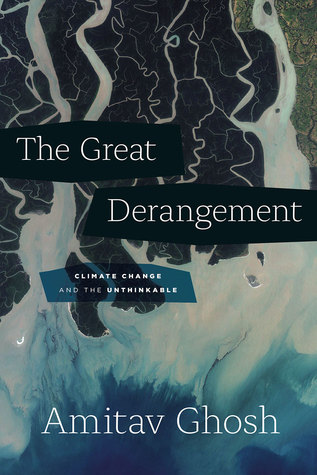
This section of Amitav Ghosh's The Great Derangement: Climate Change and the Unthinkable insightfully brings climate and geopolitcal economic forces together head-to-head. You already know which has been losing. So far, anyway. Stay tuned. After reading this exceprt, please re-read it, and substitute "coronavirus" for "climate". ~ Ed.
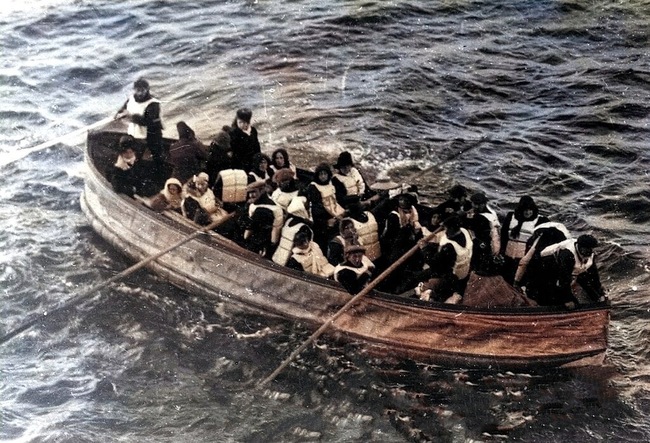
It goes without saying that if the world's most powerful nations adopt the "politics of the armed lifeboat," explicitly or otherwise, then millions of people in Asia, Africa, and elsewhere will face doom. Unthinkable though this may appear, such a Darwinian approach would not be in conflict with free market ideology: that is why it has a long pedigree in the statecraft of the Anglosphere.
Lest this seems far-fetched, let us recall that this is not the first time that British and American officialdom has had to confront catastrophes brought on by vagaries of climate. In the nineteenth and early twentieth centuries, El Nino events caused enormous disruption in India and the Philippines, and as Mike Davis has shown in his remarkable study Late Victorian Holocausts, in dealing with drought and famine, British and American colonial officials consistently placed far greater store on the sanctity of the free market than on human life. In these instances, as with the famines of Mao's China and Stalin's USSR, ideology prevailed over the preservation of life.
Malthusian ideas were also often invoked in the context of famine and starvation in Asia and Africa, as, for example, by Winston Churchill when he said, "Famine or no famine, Indians will breed like rabbits." Although we are unlikely to hear words of this kind in our era, there can be little doubt that there are many who believe that a Malthusian "correction" is the only hope for the continuance of "our way of life."
From this perspective, global inaction on climate change is by no means the result of confusion or denialism or lack of planning; to the contrary, the maintenance of the status quo is the plan. Climate change may itself facilitate the realization of this plan by providing an alibi for ever-greater military intrusion into every kind of geographic and military space. And it is quite likely that this plan commands widespread but tacit support in many Western countries. Significant sections of the electorate probably understand that climate change negotiations may have the effect of changing their country's standing in the world's hierarchies of power as well as wealth: this may indeed form the basis of their resistance to climate science in general.
The refusal to acknowledge these realities sometimes lends an air of unreality to discussions of climate change. There are some who believe, for instance, that considerations of fairness may make people more willing to accept serious mitigatory measures. The trouble with this, in relation to climate justice, is that these measures would affect some far more than others. The geologist David Archer reckons that to reach a genuinely fair solution to the problem of emissions would "require cuts in the developed world of about 80 percent. For the United States, Canada and Australia, the cuts would be closer to 90 percent." Will an abstract idea of fairness be sufficient for people to undertake cuts on this scale, especially in a world where the pursuit of self-interest is conceived of as the motor of the economy? Let's just say there is much room for doubt.
The fact is that we live in a world that has been profoundly shaped by empire and its disparities. Differentials of power between and within nations are probably greater today than they have ever been. These differentials are, in turn, closely related to carbon emissions. The distribution of power in the world therefore lies at the core of the climate crisis. This is indeed one of the greatest obstacles to mitigatory action, and all the more so because it remains largely unacknowledged. This question will probably be even more difficult to resolve than economic disparities and matters like compensation, carbon budgets, and so on. We do at least possess a vocabulary for economic issues; within the current system of international relations, there is no language in which questions related to the equitable distribution of power can be openly and frankly addressed.
It is for these reasons that I differ with those who identify capitalism as the principal fault line on the landscape of climate change. It seems to me that this landscape is riven by two interconnected but equally important rifts, each of which follows a trajectory of its own: these are capitalism and empire (the latter being understood as an aspiration to dominance on the part of some of the most important structures of the world's most powerful states). In short, even if capitalism were to be magically transformed tomorrow, the imperatives of political and military dominance would remain a significant obstacle to progress on mitigatory action.
Book excerpt reposted with permission from the author.
Author
AMITAV GHOSH grew up in India, Bangladesh and Sri Lanka and has a Ph.D. in Social Anthropology from the University of Oxford. He is the author of four books of non-fiction, two collections of essays and nine novels. His books have won many prizes and he has received eight honorary degrees, six lifetime achievement awards and four honorary fellowships. His work has been translated into more than thirty languages and he has served on the Jury of the Locarno and Venice film festivals. In 2018 he became the first English-language writer to receive India’s highest literary honor, the Jnanpith Award. In 2019, Foreign Policy magazine named him one of the most important global thinkers of the preceding decade. In 2024 he was awarded the Erasmus Prize and was elected to the American Academy of Arts and Sciences. In 2025 he was awarded the Pak Kyongni Prize by South Korea’s Toji Foundation, and in 2026 he was given a Fellowship by the Guggenheim Foundation. He is married to the writer Deborah Baker and lives in Brooklyn, New York. Read more...